Showing posts with label Wasatch Mountains. Show all posts

Wednesday, October 8, 2014

Moon Rise Over the Wasatch in October

Just a few shots of the full moon as it peaked through the clouds coming up over the mountains.


Tuesday, October 15, 2013

Fall in Provo

Just a few shots around the house and up the canyon mostly at sunset and sunrise.

Moonrise over the Wasatch Mountains.

Undergrowth in the aspens along the side yard.

Maples and fire bush. Yellow Norway maple hangs over a smaller red orange native Utah Bigtooth maple and on the left a bright red winged euonymus, also called fire bush.


Bridal Veil falls in the early morning light up Provo Canyon in the Wasatch Mountains.

Sunset colors in the sky over the cottonwood and maple trees.

Purple alyssum, the last of the summer flowers in the front garden.

Limestones of the Oquirrh Formation in the Wasatch Mountains of Provo Canyon in the early morning.

Remnants of the summer garden. The tomatillos and tomatoes that didn't quite make it.

Burr oak acorns in the gutter in front of the house.

Another view of moonrise over the sunset colored Wasatch Mountains.

Tuesday, April 30, 2013

Geology Photos from My Travels and Laboratory

These are just a few 35 mm slides that I have scanned from my old collection of places and interesting geological things.

Dunes of unique white sand at White Sands National Monument, New Mexico. The sand is made up entirely of crystals of gypsum, a very soft mineral, that is quite different from typical sand made of the mineral quartz. 

 Tracks or trails made by the fission of uranium atoms in the mineral apatite. These "fission tracks" are used to calculate the time at which the apatite grains cooled below about 100 ÂșC. They have been revealed by etching the apatite briefly in an acid solution. These particular apatite grains come from the Middle Jurassic Carmel Formation of southwestern Utah.

Mafic (dark) inclusions in granite in the Sierra Nevada along the Merced River just outside of Yosemite National Park. The dark inclusions are older rocks that were picked up as the granite magma intruded up into the Earth's crust. They did not completely melt in the liquid, molten granite, however, and you can see how the large dark inclusion cracked and some of the liquid granite oozed up into the crack.

Cracks in a solid piece of granite illuminated by a fluorescent dye that was infused into the cracks. The photo is about 3 mm across and shows the pathways for fluid movement in something that appears so solid and impervious as a piece of granite.

This photo is of a volcanic mudstone layer in the Green River Formation located in Indian Canyon south of Duchesne, Utah. The cracks are filled with hard silica, which likely dissolved out of the volcanic material (white stuff) around the cracks. The photo is about 2 feet across (0.6 m).

A fall scene looking down Pole Canyon toward Provo Canyon near Provo, Utah. The mountain on the right side of the photo is Cascade Mountain. The gray cliffs exposed above the maple covered slopes are composed of limestones and sandstones of the Oquirrh Formation (Pennsylvanian-Permian in age).

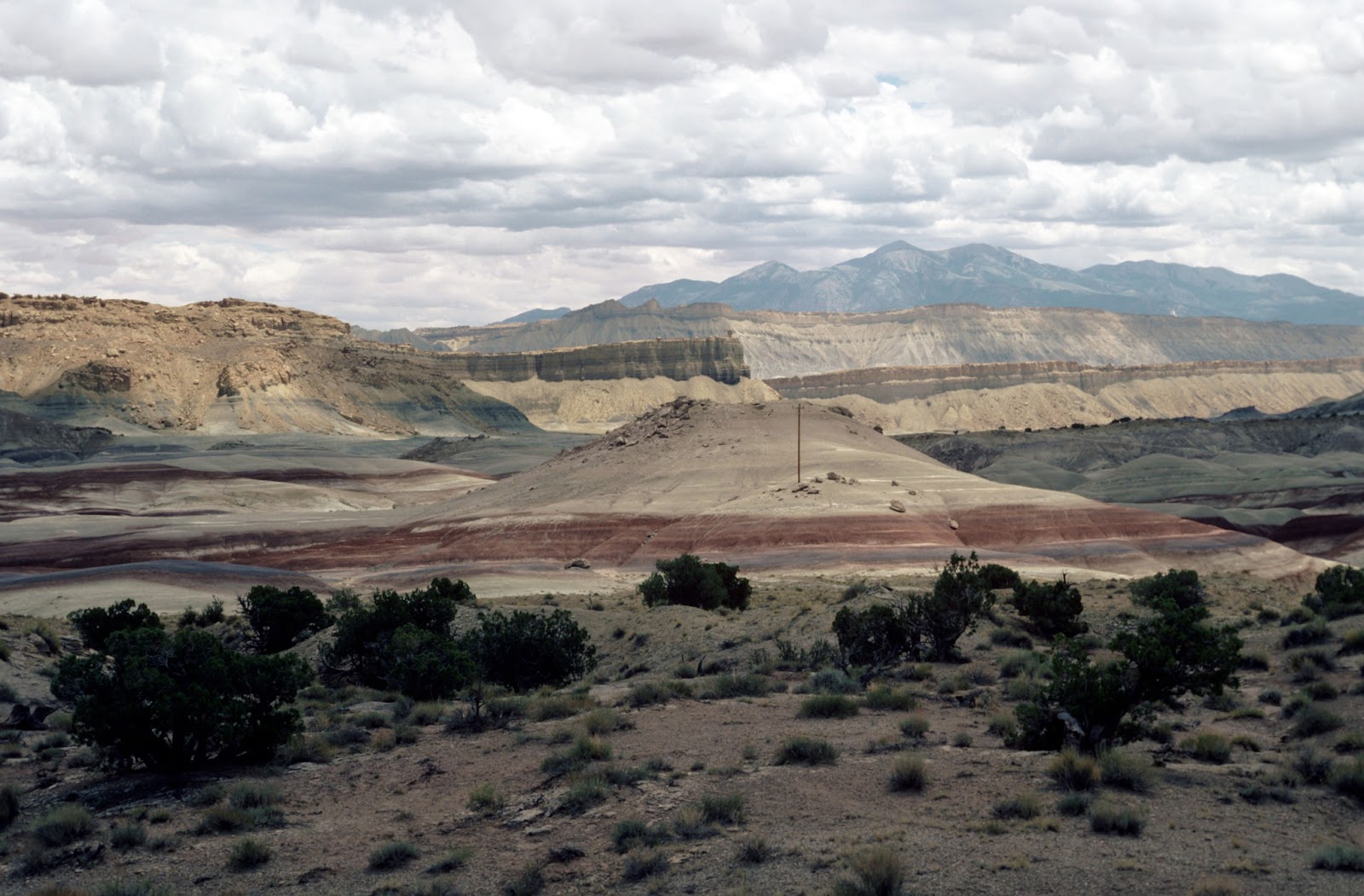
View to the east from near Capitol Reef National Park. The low hill in the middle of the picture with the brick red stripe at the bottom is the Morrison Formation (Late Jurassic) capped by some sandstones of the Cedar Mountain Formation (Early Cretaceous). Behind the hill are the gray slopes formed by the Tununk Shale Member of the Mancos Shale (Cretaceous), which are capped by tan sandstones of the Ferron Sandstone (Cretaceous). In the far distance, the Henry Mountains peaks can be seen. The Henry Mountains are composed of diorite porphyry intrusions of Oligocene age.

Sunday, April 21, 2013

The Mountain in Our Backyard -- Mount Timpanogos

Here are a few shots I have taken over the years of one of nature's most beautiful mountains: Mount Timpanogos in the Wasatch Mountains of Utah. Even though Timp is only 11,752 feet high, it rises abruptly from Utah Valley, with an elevation difference of over 5,000 feet. The upper parts of the mountain were glaciated during the last ice age, carving the top into its present form.

Most of the mountain is comprised of the Oquirrh Group, a series of Pennsylvanian-Permian age limestones and sandstones that were deposited in the ocean about 300 million years ago when Utah was at the edge of the North American continent. The rocks have since had an interesting history including deep burial, uplift, and erosion to form them into the current spectacular mountain. Several of the photos here were taken from my backyard and others as I have traveled around the mountain.


Saturday, March 10, 2012

Spring has arrived in the mountains

Yellow crocuses in the front yard. Provo, Utah, March 10, 2012.

Sunset on Mount Timpanogos from my backyard in Provo, Utah on March 10, 2012.

Purple crocuses with a honeybee digging for pollen on March 10, 2012 in Provo, Utah

Sunset in St. George, Utah in January 2012. No color enhancements have been made to this photo.

Saturday, October 1, 2011

Wasatch Mountains, Utah - Fall 2011

Photos taken in September 2011. [Click on the images for a larger view.]

Mount Timpanogos looking to the west

Mount Timanogos

Mount Timpanogos from Charlestown across Deer Creek Reservoir

Pond on golf course in Midway, Utah

Fall Colors near Midway, Utah

Wasatch Mountains from Midway, Utah
(All pictures were taken by Urthman and may not be reproduced without permission)

Wednesday, October 7, 2009

Fall in the Wasatch Mountains, Utah

All of these pictures are of the Wasatch Mountains west of Midway, Utah taken in late September 2009.


(All photos were taken by Urthman, and may not be republished without permission)

Friday, June 19, 2009

Geology Field Camp 2009

Photos taken during May 2009 during BYU geology field camp. Click on the photos for an enlarged view.View of the Wasatch Mountains from Allen's Ranch.

Fossil gastropod (marine snail) in Gardison Formation.

A different gastropod in the Gardison Formation.

Fossil coral in the Gardison Formation.

Indian paintbrush on rocky slope.

Chimney Rock Pass with Chimney Rock in the center.